
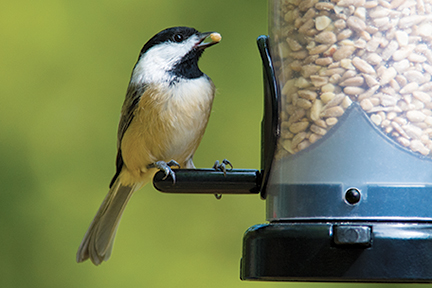
Kinglets - Highly caffeinated little bundles of feathers!
Ruby-crowned Kinglets and Golden-crowned Kinglets can be found in the Conejo Valley usually starting in late September and they both leave the area around April. Ruby-crowned Kinglets are in the area in fairly large numbers and may be seen in yards foraging for bugs. Golden-crowned Kinglets, however, come into the area in low numbers, so getting to see one can be a fun treat!
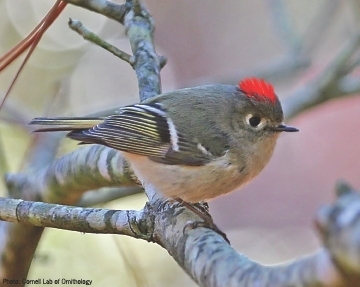
- The Ruby-crowned Kinglet is a tiny bird that lays a very large clutch of eggs—there can be up to 12 in a single nest. Although the eggs themselves weigh only about a fiftieth of an ounce, an entire clutch can weigh as much as the female herself.
- Ruby-crowned Kinglets seem nervous as they flit through the foliage, flicking their wings nearly constantly. Keeping an eye out for this habit can be a useful aid to identifying kinglets.
- Metabolic studies on Ruby-crowned Kinglets suggest that these tiny birds use only about 10 calories (technically, kilocalories) per day.
- The oldest known Ruby-crowned Kinglet was a female, and at least 4 years, 7 months old, when she was recaptured and re-released during banding operations in California in 2007. She had been banded in the same state in 2003.
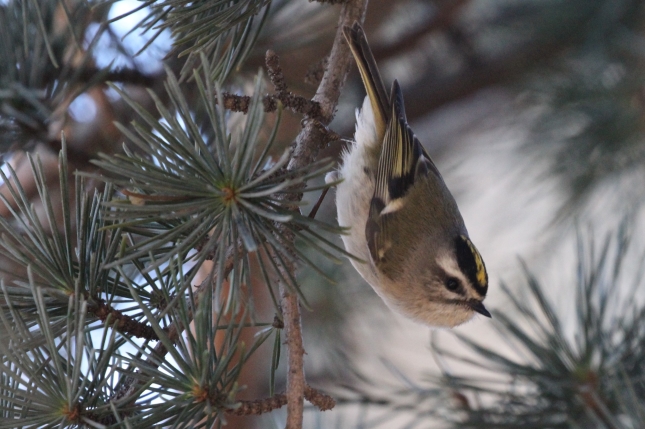
- The tiny Golden-crowned Kinglet is hardier than it looks, routinely wintering in areas where nighttime temperatures can fall below –40° Fahrenheit.
- Although it used to nest almost exclusively in boreal spruce-fir forests, the Golden-crowned Kinglet has been expanding its breeding range southward into conifer stands of the Midwest and Appalachians.
- The Golden-crowned Kinglet usually raises two large broods of young, despite the short nesting season of the northern boreal forest. The female feeds her first brood only up until the day after they leave the nest. She then starts laying the second set of eggs while the male takes care of the first brood. The male manages to feed eight or nine nestlings himself, and he occasionally feeds the incubating female too.
- Each of the Golden-crowned Kinglet's nostrils is covered by a single, tiny feather.
- The oldest Golden-crowned Kinglet on record was a male, and at least 6 years, 4 months old when it was recaptured and rereleased by a Minnesota bird bander in 1976.